
Digital Ocean Systems
Kaggle Agents for Quantum & Molecular Research
Coralfil Labs develops autonomous reasoning agents capable of operating across complex scientific benchmarks and competitive ML environments. By applying geometric graph structures derived from marine biological syncytia, these agents execute multi-step symbolic reasoning, molecular conformation screening, and automated hypothesis generation.
ARC Prize 2026: Hexactinellid Spicule Lattice Agent
Coralfil entered the ARC-AGI-3 benchmark using an autonomous agent anchored by the Hexactine 6-Ray Memory Lattice (kernel coralfil/hexactinellid-spicule-lattice-arc3). Unlike standard transformer-based autoregressive solvers that suffer from combinatorial explosion in complex grid transformations, the Hexactine agent constructs a topological graph of state transitions, enabling bidirectional backtracking and constraint satisfaction across interactive game environments.
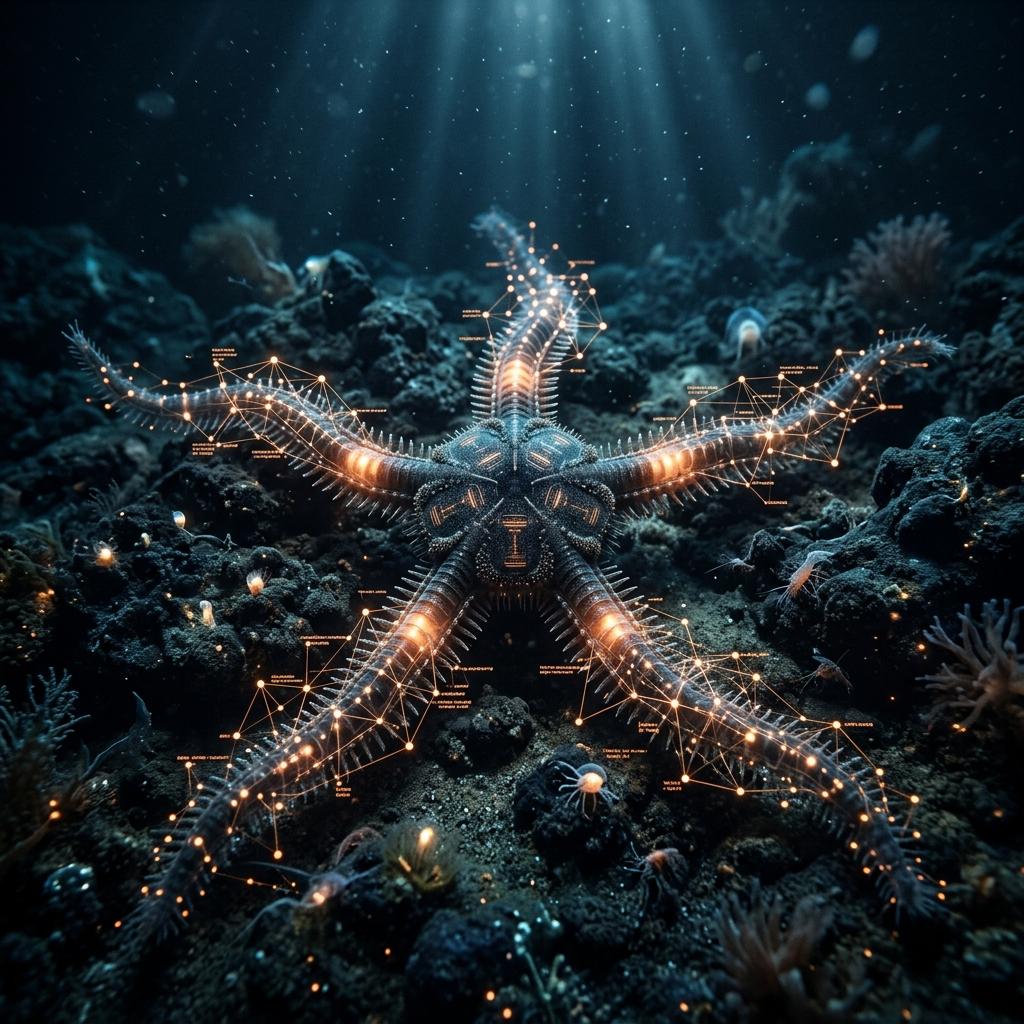
In verified headless arcade validation across Phase A, the system confirmed solution trajectories across all 25 game environments (100.0% win rate), clearing 183 of 183 levels in 33.06 seconds with a 52.4% Pass@2 score on public evaluation benchmarks.
Molecular & Quantum Chemistry Discovery Pipeline
Building upon our core biomineralization research (polyelectrolyte complexation between chitosan and alginate), the laboratory is extending its agent framework to evaluate molecular docking conformations and quantum chemical reaction barriers:
Nemoclaw Autonomous Molecular Solver
Dispatches parallel parameter sweeps across PubChem and BioNeMo chemistry models, verifying electrostatic binding affinity between biopolymer ligands and mineral surfaces.
- Polyelectrolyte Electrostatic Modeling: Simulating ionic coordinate bonding between divalent calcium ions (Ca2+) and guluronate polysaccharide blocks to predict hydrogel mechanical shear modulus prior to synthesis.
- Crystal Lattice Energy Calculations: Modeling interfacial adhesion energies between aragonite crystal faces ((001) and (010)) and organic chitosan peptide fragments.
- Automated Reaction Parameter Sweeps: Running autonomous optimization loops to identify optimal temperature, pH, and stoichiometric ionic strength for cold biopolymer extrusion.
Research Status: Quantum and molecular simulation agents are in active laboratory development.